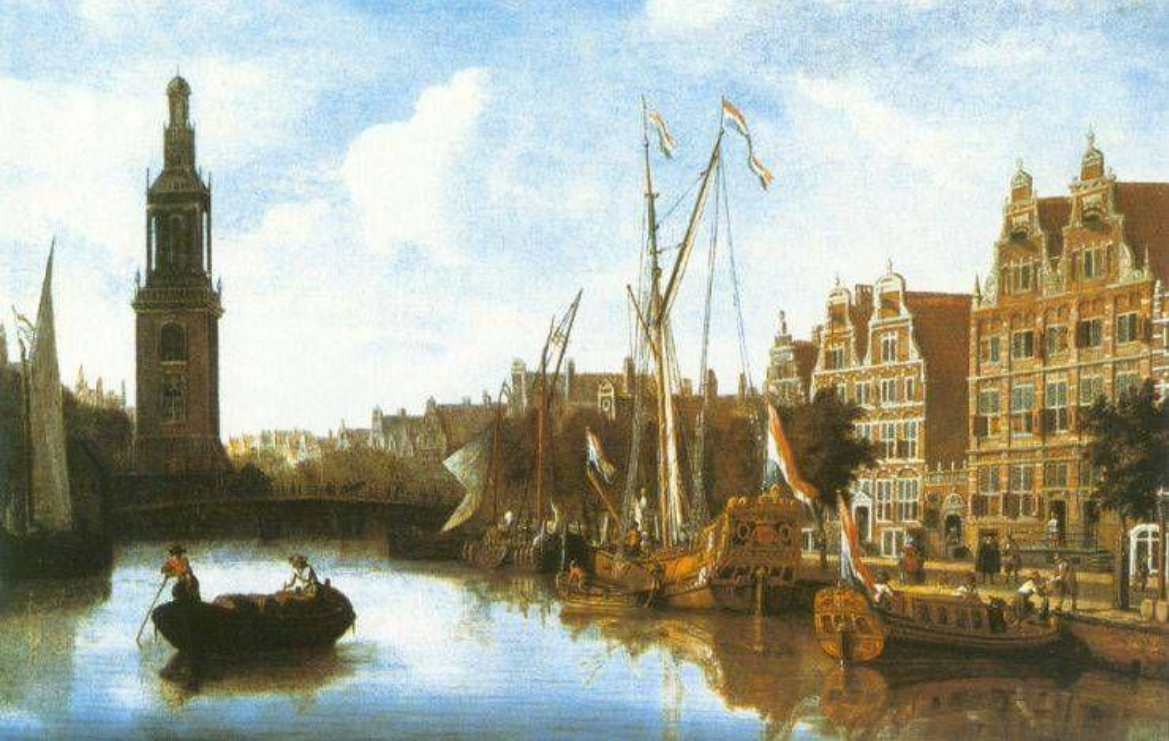
Gezicht op het Singel by Jan Roodenpoortstoren (1684)
The Dutch call the 17th century "The Golden Age" because, during that time, the Netherlands became one of the strongest countries in the world. In several respects, it was arguably the dominant force of its time. As a Dutchman myself, I know about this successful past, but it seems that few people know that the Netherlands outcompeted Great Britain and Spain during the 1600s, and perhaps even overpowered them.
By the middle of the 1600s, the Dutch Golden Age had reached its peak. Established European powers, long accustomed to political and military dominance, suddenly found their position challenged by the rapid rise of the Dutch Republic. So, by the mid-17th century, these powers sought to sabotage the Republic´s ascend. Several wars ensued, and they culminated into a grand coalition of ´old powers´ versus the Netherlands in the year 1672. France, England, and several German states coalesced to pin the Netherlands from all sides. The threat was in fact so intense that a complete Dutch surrender was the most obvious outcome. Through a series of miracles the Netherlands remained standing during its most testing year of the 17th century.
Through this series of artworks, we will explore the military reasons why the Dutch refer to 1672 as the Rampjaar, or "Disaster Year." While there were many reasons why 1672 became synonymous with disaster, this online museum gallery focuses exclusively on the military events that threatened the very existence of the Dutch Republic.
The Nieuwezijds Voorburgswal, Amsterdam by Gerrit Adriaenszoon Berckheyde
(1638–1698)
The Amsterdam canals themselves, as well as most of the estates alongside them were created in this golden era, and the paintings like the one we see above were created en masse: some historians estimate that a whopping 5 million paintings were created during this age (which is 2.5 paintings per capita over those 100 years). Paintings were seen as investments at the time, and even poorer classes hung paintings in their houses
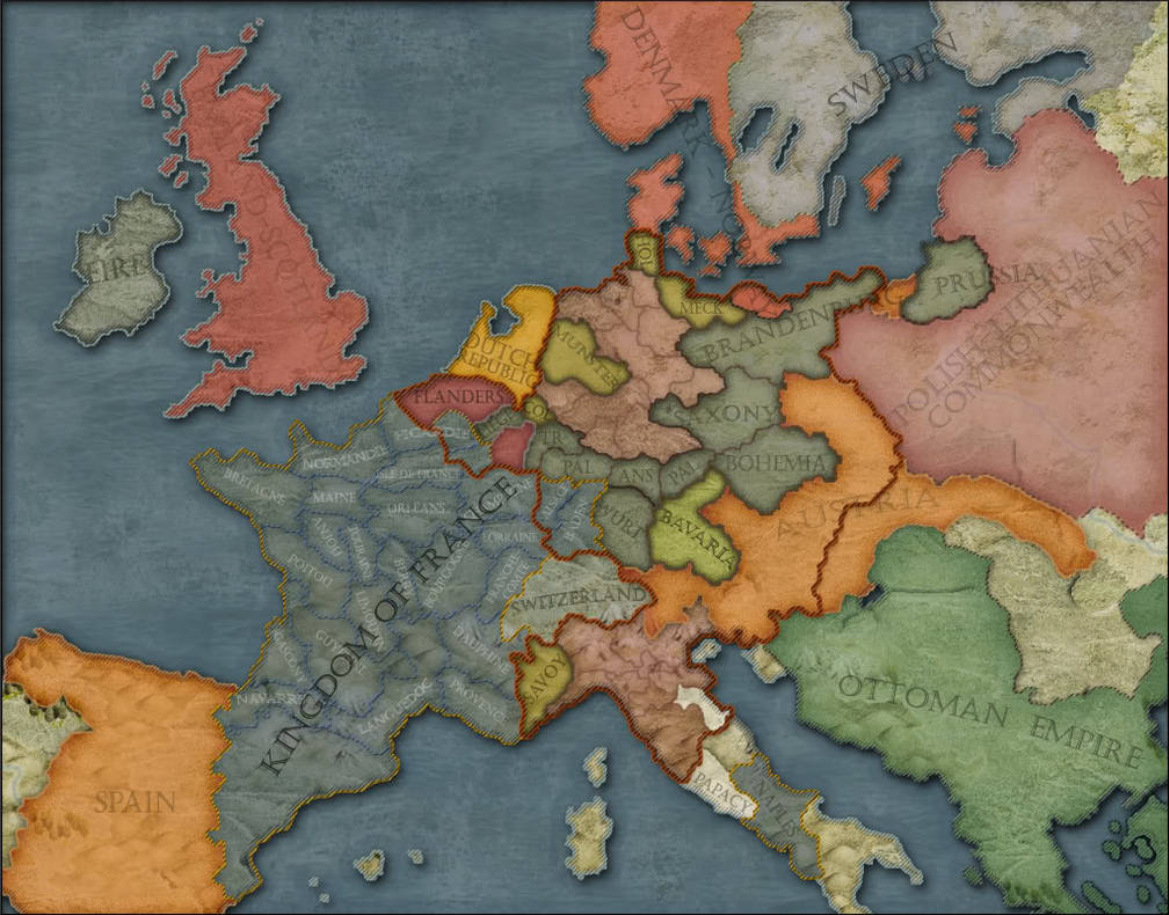
A map of Europe in 1672
As the Dutch Republic amassed increasingly more wealth throughout the first half of the 17th century, all the established powers enviously witnessed the Netherlands become ever-mightier. The Dutch mercantile empire fostered not only financial leverage, but also political prestige, the funding of a formidable navy under a very intricately functioning company called the VOC, the Dutch East India Company, which is the wealthiest company to have ever existed, worth an estimated 7 to 9 billion current-day US Dollars.
Because Holland´s competing commercial dominance the established European powers sought to challenge and halt the Dutch free trading capacity. There were many wars against the Netherlands between 1600 and 1700, but one could say the strongest test occured in 1672, the ´Rampjaar´ where England, France, Cologne and Münster coordinated an attack from multiple directions.
- France invaded from the South
- England threatened over sea
- Münster and Cologne attacked from the east
Through a series of miraculous successes the Netherlands was able to thwart all the three invasion attempts and - quite literally - remain afloat.
Louis XIV crossing the Rhine, 12th June 1672 by Adam Frans van der Meulen (created some time between 1672 and 1690)
Let us go over the 3 prongs of attack that challanged the Dutch Republic´s very existence in 1672. The established powers wanted to eradicate the Dutch commercial position completely, and annul their competitive power forever. The ´Disaster Year´ of 1672 was a battle of Dutch existence, A D-Day of sorts, if you will.
The French invaded the Netherlands from the South, and the painting above actually strikes many resembles with another WW2 event: Operation Market Garden (a bridge too far). In this painting you can see how the extensive French forces - successfully - crossed the river Rhine.
School illustration created by Jan Hoynck van Papendrecht (1917)
Although the French army crossed the Rhine with remarkable success, its advance was ultimately halted by the Dutch Water Line. By deliberately flooding vast areas of land, the Dutch transformed their landscape into a defensive barrier that the French could not easily cross. Combined with logistical difficulties and growing Dutch resistance, the invasion stalled before the heart of the Republic could be conquered.
Here we see the Netherlands' stadtholder (a sort of ´commander´ of the Netherlands for lack of a king), William III from the House of Orange. This Dutch royal later became king of England during the famous
, which also led to a significant transfer of Dutch knowledge, capital, and expertise to England, helping strengthen its financial infrastructure and ties with mainland Europe.
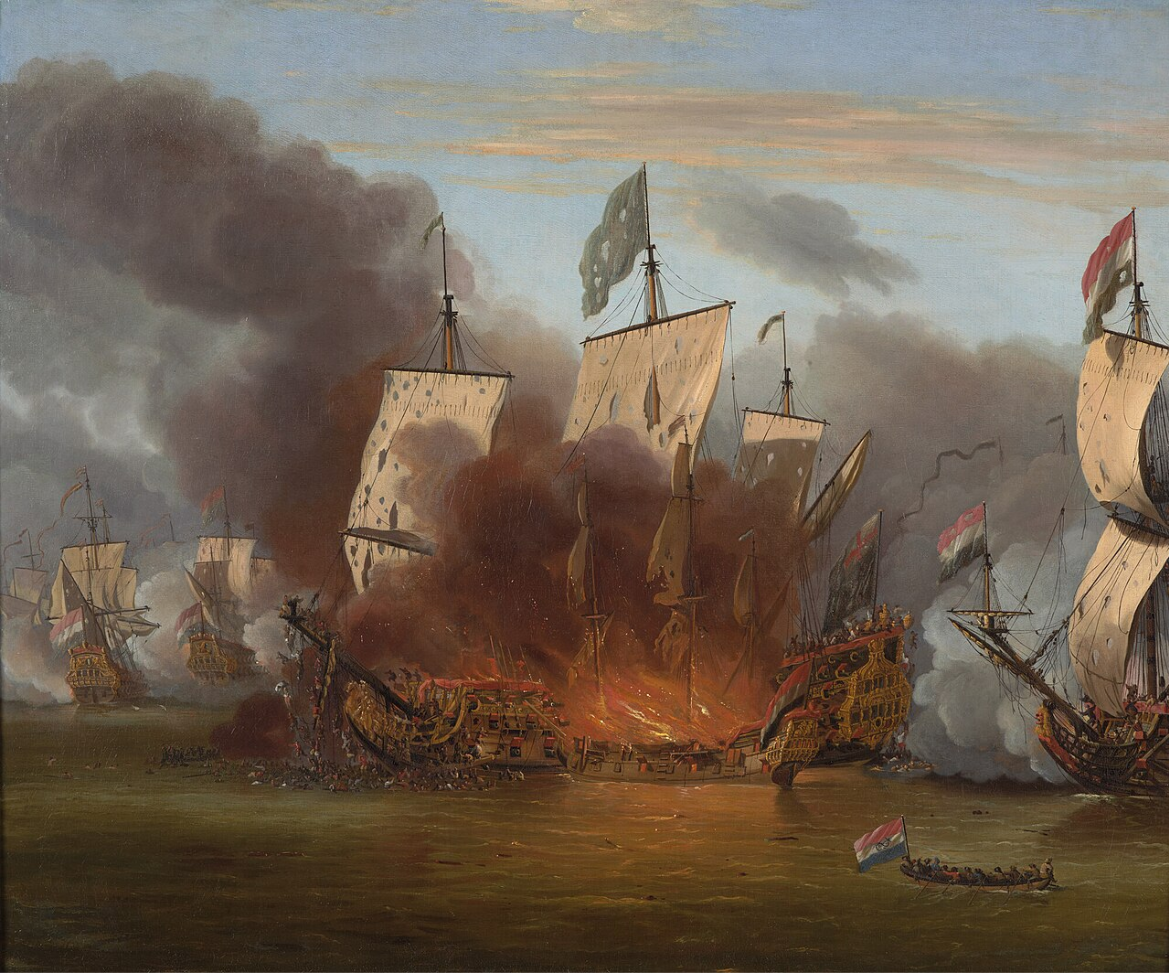
Burning of the Royal James at the Battle of Solebay by Willem van de Velde II (c. 1675
Having covered the invasion attempt from the South by the French Kingdom, this painting covers the second prong of attack: England´s naval assault along several parts of the Dutch coast throughout the Disaster Year.
In this dramatic naval scene, Dutch marine painter Willem van de Velde the Younger depicts the burning of the English flagship Royal James during the Battle of Solebay. The elements of this painting typify the chaos of seventeenth-century naval warfare. Thick smoke, exploding cannon fire, and ships crowded together.
The destruction of the Royal James was symbolically powerful and demonstrated that the Dutch Republic was a formidable naval power and could compete on an equal- and perhaps even superior basis against the English fleet. The painting also highlights the importance of sea power: while French armies threatened the Republic on land, control of the sea was essential for Dutch survival and trade.
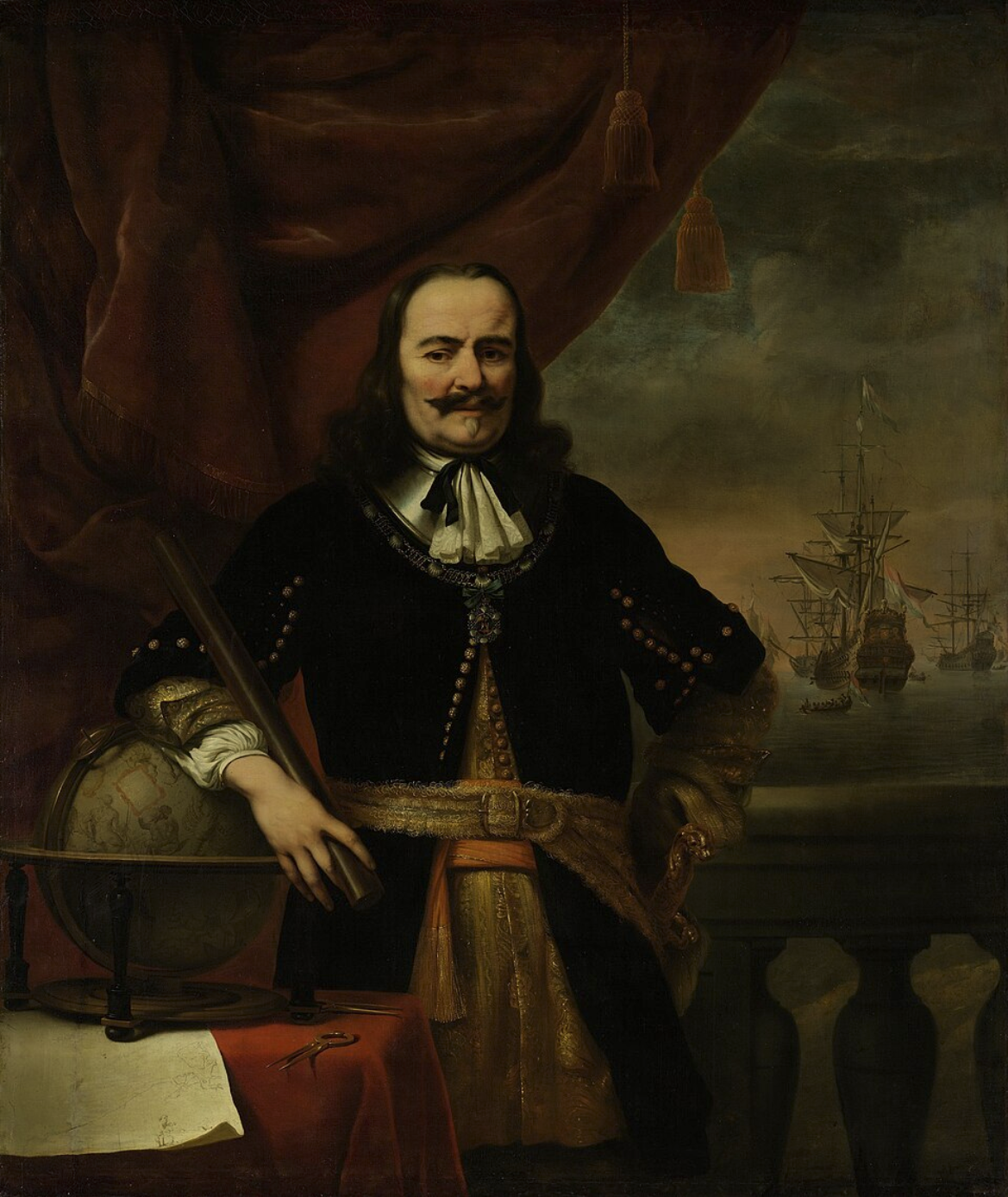
Michiel de Ruyter as Lieutenant-Admiral by Ferdinand Bol (1667)
Besides the Battle of Solebay, there were 3 other major Naval battles along the Dutch coast around this time. An admiral by the name of Michiel de Ruyter is widely regarded as having been pivotal in these Dutch naval successes: he denied the coalition to set foot on land by means of military transport across ´the Canal´, the seastraight connecting the Netherlands and Great-Britain. Partly because of these successes, there is no other military commander that occupies as prominent a place in Dutch national memory as Admiral Michiel de Ruyter - one could say he is the ´ultimate hero´ of the Netherlands, rivaled by none.
In this painting you can see the flagship ´De Zeven Provinciën´, named after the 7 states of the Dutch Republic. From this ship De Ruyter´s military genius disabled the creation of transportation alleyways across the canal. De Ruyter is renowned for maneauvering his ship aggressively during battles: he was not shy to take practical lead in battle.
Het beleg van Groningen in 1672 by Folkert Bock (1686)
The final prong of the coalition's attack came from the east. While French armies advanced across the Rhine and England threatened from the sea, the Prince-Bishoprics of Münster and Cologne invaded the Dutch Republic's eastern and northeastern provinces. Led by the Prince-Bishop of Münster, Bernhard von Galen, the invading forces captured several towns and appeared poised to exploit the Republic's growing vulnerability.
This painting depicts the Siege of Groningen, one of the most important engagements of the eastern campaign. Groningen was a strategically vital fortress city guarding the northern approaches to the Republic. Its successful defence prevented Münster and Cologne from establishing a stronger foothold in the north and denied the coalition another avenue of advance into Dutch territory.
Gezicht op de Bloemenmarkt op het Singel met op de achtergrond de Munttoren,
Amsterdam by Jan Gerard Smits (c. 1900)
The final prong of the coalition's attack came from the east. While French armies advanced across the Rhine and England threatened from the sea, the Prince-Bishoprics of Münster and Cologne invaded the Dutch Republic's eastern and northeastern provinces. Led by the Prince-Bishop of Münster, Bernhard von Galen, the invading forces captured several towns and appeared poised to exploit the Republic's growing vulnerability.
This painting depicts the Siege of Groningen, one of the most important engagements of the eastern campaign. Groningen was a strategically vital fortress city guarding the northern approaches to the Republic. Its successful defence prevented Münster and Cologne from establishing a stronger foothold in the north and denied the coalition another avenue of advance into Dutch territory.
Gezicht op de Bloemenmarkt op het Singel met op de achtergrond de Munttoren, Amsterdam by Jan Gerard Smits (c. 1900)
If you ever walk along the beautiful canals of Amsterdam, perhaps you are now better able to understand why it feels like you are walking inside a painting.
You may also appreciate that the Netherlands was almost capitulated during its ´Disaster year´ 1672. Through purely military perspectives we experienced in this gallery how the Netherlands was tested from many angles: unhappy neighbors out for Holland´s dominant commercial position.
(end of gallery)